Predicting long-term building energy consumption using multiple feature clustering and machine learning: applications in Shanghai, China
Sep 1, 2024· ,·
0 min read
,·
0 min read
Yukai Jin
Ayyoob Sharifi
Abstract
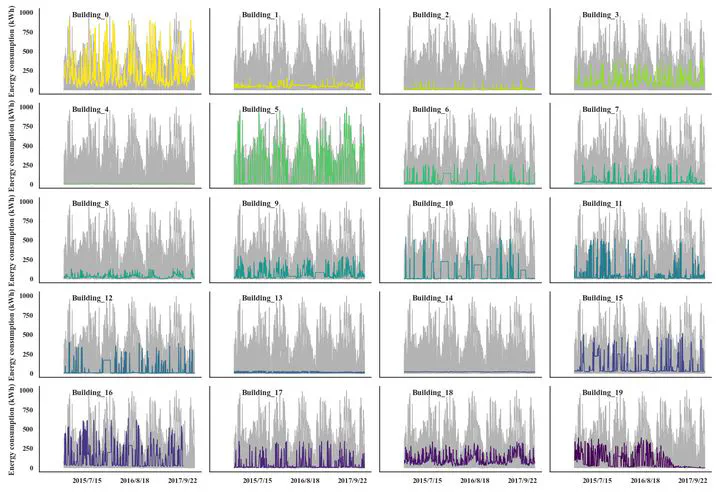
As urbanization progresses, global building energy consumption is on the rise, emphasizing the need for a dependable energy consumption prediction model. This study presents a multi-stage machine learning approach comprising a clustering decomposition model (GMM), a prediction model (XGBoost), and an optimization model (PSO). Prior to clustering, the RF model evaluates the significance of various features influencing building energy consumption. GMM partitions the data into distinct clusters, while the PSO model fine-tunesthe initial parameters of XGBoost. Validation is conducted using a dataset comprising 458,836 hourly records spanning three years from 20 office buildings in Shanghai, China.The average hourly energy consumption for all buildings is 79.2 kWh, but there is significant variation, with a standard deviation of 126.3 kWh.The prediction results indicate that the proposed model consistently achieves an R² exceeding 0.85 across diverse test sets, demonstrating robust accuracy and generalization capabilities. These findings offer valuable insights for future building design and energy management strategies.
Date
Sep 1, 2024 1:00 PM — Sep 5, 2024 3:00 PM
Event
Location
TOKI MESSE
Niigata, Japan